27 May 20265 min readJeremy Murray
2026 AI Predictions: Why Cost-Cutting Could Weaken Companies
More AI won't automatically create better businesses. Heading into 2026, many companies still run on two instincts: cut costs and avoid regulatory trouble.
That mindset makes AI easy to sell and easy to misuse. The bigger risk is not the model itself, it is the habit of treating every human role as a cost to remove.
Why efficiency is beating judgment
Many firms now act in two modes: reduce spending and stay out of trouble. That leaves marketing, innovation, and R&D in a weak spot, because those functions need patience, money, and measured risk.
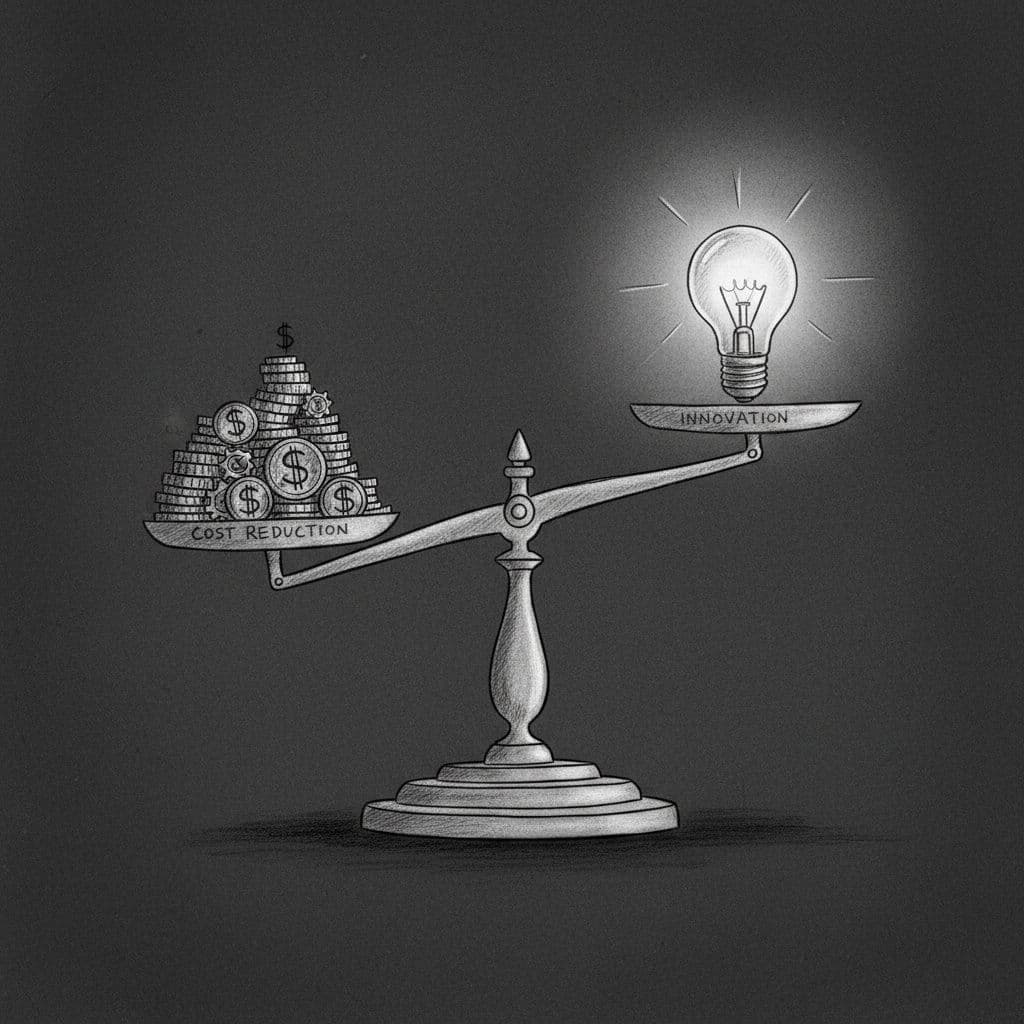
A classic management view says a business exists to find and keep a customer. In that frame, marketing and innovation create value, while the rest of the company supports them. That idea still sits at the heart of Peter Drucker's management theory. Yet many boards now follow a colder model, where customers are assumed to know what they want and the firm's job is to deliver it at the lowest possible price.
That split mirrors two schools of thought. The Austrian view treats value as subjective, so brand, context, and experience matter as much as production. The Chicago-style view fits neatly into spreadsheets, so it wins more budget meetings. One sees business as a discovery mechanism. The other sees it as an efficiency machine.
A company that only optimizes what it can count may cut away the reasons customers stay.
The doorman fallacy and the first wave of AI
AI enters this climate with a simple sales pitch: reduce headcount. That pitch rests on a familiar mistake. A hotel doorman can be defined as the person who opens the door. Replace that person with an automatic door and the saving looks clean. But the hotel also loses security, warmth, local knowledge, help with taxis, recognition for regular guests, and a signal of status.
Consultancies often love this logic because gain-share deals let them take a cut of measured savings. Few of them carry the cost when value disappears months later.
Self-checkout is the supermarket version of the same mistake. As a choice, it works well for someone with a few items. As the default, it turns shoppers into unpaid staff. A large family shop becomes awkward, theft rises, and stores learn that produce codes can quietly turn avocados into onions at the till.
What gets counted is easy to spot:
- labor removed from the budget
- faster service targets on paper
What gets missed takes longer to show:
- lost sales from friction
- weaker loyalty
- more theft and a worse store experience
That is why the first phase of AI is likely to be "same, but cheaper." In practice, it may feel more like "same, but worse."
Human contact is worth more than the spreadsheet shows
The hardest part of service to measure is often the part customers remember most. One postal example made that clear. Better delivery performance barely changed how people felt about the brand. What mattered more was whether they liked their local postie. A helpful person who knew where to leave a parcel could lift the whole company in a customer's mind. A rude one could drag it down, even if operations ran well.
Property sales show the same pattern. Agents often try to keep buyer and seller apart until late in the process because a personal dislike can kill a deal, even when the price is right. Human response still beats formal logic.
The same blind spot hurts call centers. Some agents calm angry customers, save accounts, and protect future revenue at a level that could justify six-figure pay. Still, their value is hard to prove quickly, so finance teams underpay it.
This is also why websites hide phone numbers. Leaders push customers into the cheapest channel and claim the savings. One online travel business found website visitors converted at about 0.5 percent. People who phoned converted at about 30 percent. The phone line cost more per interaction, but it sold far more.
Marketers have long argued that more channels create more buying situations. Push everyone into one low-cost route and the business may shrink while support costs fall. Behavior also changes slowly, so companies often mistake silence for acceptance. In a market full of bots and self-service, human contact may become the clearest form of difference.
How AI adoption is likely to unfold
The likely path for AI looks less dramatic and more familiar.
| Phase | How companies use AI | What happens |
|---|---|---|
| Same but cheaper | Headcount cuts and more self-service | Costs fall, service often gets worse |
| Same but better | Staff use AI to help customers faster | Experience improves |
| New model | Teams redesign the whole process | New products and ways of selling appear |
The second phase may belong to founder-led businesses and firms that can think past the next quarter. Recent effectiveness awards leaned toward brands with patient brand-building cultures, including McCain, Waitrose, Yorkshire Tea, Specsavers, and Guinness. That pattern suggests long-horizon thinking still matters.
There is also a simple commercial opening here. When every rival strips out people, the company that does the opposite may stand out. In a crowded automated market, different can beat better.
Real gains appear when the process gets rebuilt
The third phase starts when companies stop bolting new tech onto old habits. Early factories made this mistake with electric motors. They replaced one large steam engine with one large electric motor and saw small gains. Productivity jumped only after each machine got its own smaller motor and the whole factory layout changed.
Marketing may follow the same path. Old production often worked like a bespoke Faberge egg, made after a client asked for it. Mass production flipped that model, make the dinner service first, then go find the buyer. Cheap, fast content could push agencies toward that same reversal.
Instead of waiting for a brief, some teams may make work first and then look for a brand that wants it. Creator-led campaigns already hint at this model. Even Cannes could drift closer to a trade fair, with less time spent showing last year's work and more time spent selling finished ideas.
Why the marketer still needs a seat in the room
Marketing's best defense is not a list of outputs. It is a way of thinking. When marketers sell only campaigns, media plans, or creative, they sound like a cost center asking for mercy from finance.
Without a customer view in the room, smart teams can make dumb choices.
The Concorde showed that years ago. Flying from London to New York looked magical because the plane beat the time zone. The return leg was much less appealing. Passengers needed an extra hotel night, an early airport trip, and then lost most of a workday in the air. The engineering was brilliant. The human experience was not.
That 180-degree flip matters because engineers, operators, and finance teams can optimize speed, cost, and capacity while missing how people judge the experience. Marketing prevents that mistake by looking from the customer's side first. The strongest marketers do not sell what they do. They sell how they think.
What matters after the AI rush
The near future of AI may reward companies that can claim savings fast. That reward can hide the value lost through weaker service, less trust, and fewer sales.
The businesses that come out ahead will not be the ones that automate the most. They will be the ones that protect human value while using AI with better judgment.
Share
Sign up for more like this
No spam. No jibber jabber. Unsubscribe any time.